
Presque Isle Release Date Meanings
Michigan OTIS does not use one simple “projected release date” label. Its key public terms are Earliest Release Date and Maximum Discharge. The Earliest Release Date, or ERD, comes from the Judgment of Sentence and usually marks when the Michigan Parole Board obtains jurisdiction for an indeterminate sentence. It is an eligibility point. It is not an appointment for someone to leave prison. Maximum Discharge is the outside sentence date if parole does not occur sooner, subject to the law and any applicable sentence treatment.
Date Paroled is stronger evidence of physical release from prison. MDOC describes it as the date the person left prison or camp, or acquired parolee status while in another placement. Read that date with current status. Parolee means the person has left prison but remains under state supervision. Discharged means MDOC custody and supervision have ended. An ERD that has passed without either status does not prove release.
Presque Isle Custody Date Paths
The correct source follows the legal status. A person awaiting trial at the Presque Isle County Jail has no sentence-based release calculation. Bond, dismissal, a recognizance order, a detainer, or another court action can control the next move. A sentenced county-jail person may have an internal date based on the judgment, jail credit, and applicable county good time. A state prisoner has MDOC date fields and parole procedures. These three paths cannot be merged into one formula.
| Status | Best date source | What the date means |
|---|---|---|
| Pretrial county detainee | Jail and court of record | No fixed sentence date; release depends on current legal authority. |
| Sentenced county inmate | Presque Isle County Jail record | The jail’s current calculation after sentence credit and lawful county good time. |
| MDOC prisoner | OTIS and MDOC | ERD and Maximum Discharge must be read with status and parole action. |
| Parolee | OTIS supervision record | Date Paroled supports prison exit, while supervision continues. |
| Discharged person | OTIS or MDOC records | Recent completion of MDOC custody and supervision. |
A transfer can also end one custody record without creating community release. If a county name disappears and OTIS shows Prisoner, state custody began. A detainer may send the person to another county or authority. Ask for the release disposition and receiving agency whenever the physical destination matters.
Lookup Presque Isle Release Dates
For a state case, open the MDOC OTIS search. The form accepts last and first name, a six-digit MDOC number, sex, race, age, offender status, and marks, scars, or tattoos. The number is the most precise key. Status filters include Prisoners, Parolees, Probationers, Discharged, and absconder categories. Match identifying facts before reading the date fields.
- Decide whether the person is pretrial, serving a county sentence, or serving an MDOC sentence.
- For MDOC custody, search OTIS by number or name and compare identity details.
- Read ERD, Maximum Discharge, Date Paroled, and current status as separate fields.
- For a county sentence, call the jail and ask for the current calculated release date.
- Use the court docket to confirm the judgment, sentence, jail credit, and later orders.
- Ask whether a warrant, detainer, or transfer will prevent community release.
The MiCOURT Case Search can show bond, judgment, sentence, credit for time served, and later orders. It explains legal authority, but it may not show the jail-door time. The 89th District Court handles misdemeanors and preliminary felony stages, while the 53rd Circuit Court handles felony trials and sentences. Use the court that holds the case.
Note: An online date should be checked against current status, the sentencing record, and any receiving-custodian information.
Presque Isle Release Time Rules
Michigan uses two sharply different time systems for these Presque Isle County records. Under MCL 51.282, a sentenced county-jail prisoner with no conduct violations earns one day of reduction for each six days of sentence. The Sheriff may set forfeiture amounts, take earned time for violations, and restore some time in allowed circumstances. MCL 51.283 requires the jail rules and good-behavior allowances to be posted. The actual Presque Isle County calculation must still come from the jail.
This county rule does not create a date for an unsentenced pretrial detainee. There is no fixed term to reduce. It also does not cancel a detainer, warrant, or court order. A person may finish the county sentence yet move directly to another custodian. For that reason, ask both for the calculated end date and the release disposition.
Covered MDOC truth-in-sentencing cases use a different rule. Listed assaultive crimes committed on or after December 15, 1998, and all other covered crimes committed on or after December 15, 2000, require service of the full judicial minimum before parole consideration. Good-time and disciplinary credits do not shorten that minimum. Class I misconduct produces disciplinary time for the Board to consider. Michigan’s covered rule is 100% of the judicial minimum, not an 85% formula.
The official MDOC truth-in-sentencing page is the source for the full-minimum rule shown below.
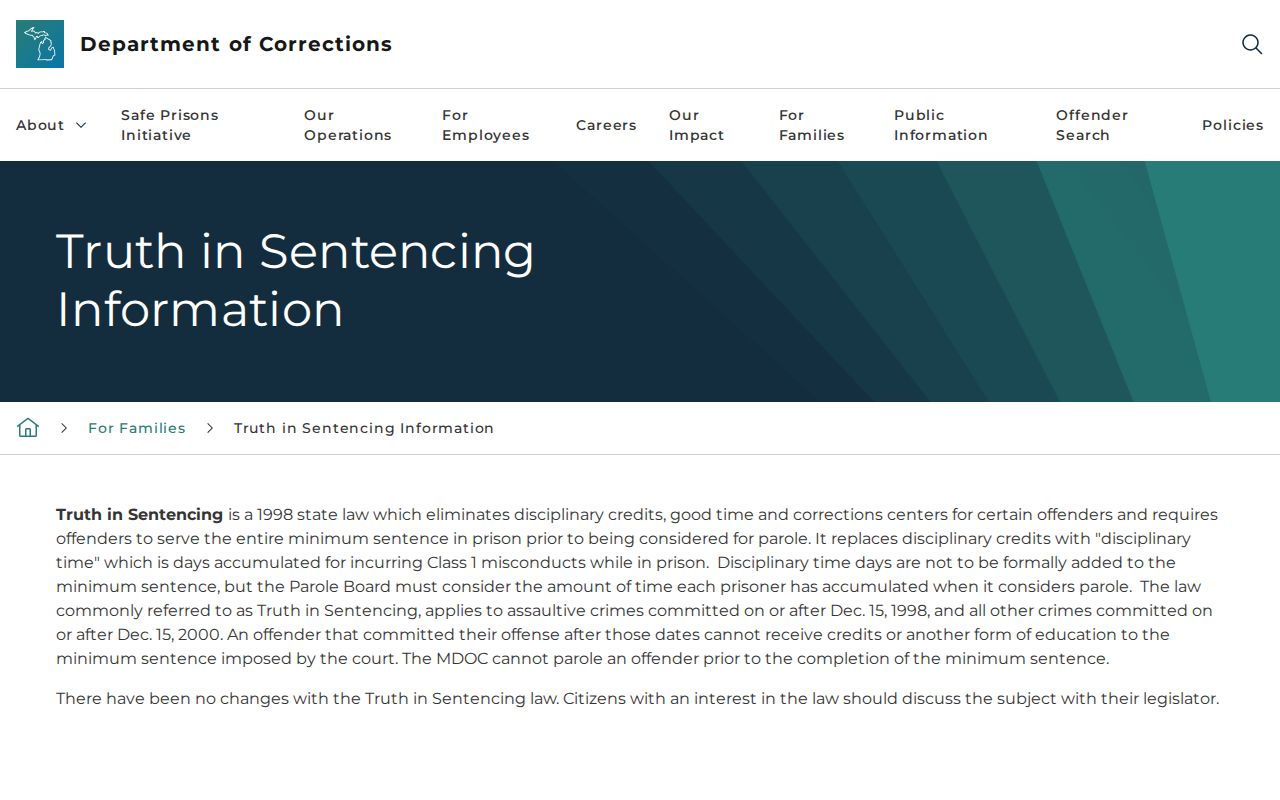
The image supports the state-prison rule. It does not calculate a Presque Isle County Jail release date or establish an actual prison departure.
Presque Isle Legacy Release Records
Older MDOC cases can use legacy credit rules. Offense date and statute determine whether good-time or disciplinary-credit treatment survives. MCL 791.234 refers to minimum terms less applicable credits, while MCL 800.34 identifies prisoners subject to disciplinary time. A broad internet formula cannot resolve those dates. OTIS and MDOC time computation are the proper sources.
OTIS displays people discharged from MDOC for three years after discharge. When that window closes, absence is not proof that no state record exists. MDOC identifies a past-prisoner records contact for up to six years after release, and its FOIA office handles public-record requests. The sentencing court may also retain the judgment and later orders. A focused request should ask for the existing release or discharge record and specify the full name, date of birth, and MDOC number when known.
- Indeterminate sentence
- A state sentence with a judicial minimum and a statutory maximum.
- ERD
- The eligibility point when the Board generally obtains jurisdiction, not a guaranteed exit.
- Maximum Discharge
- The outside sentence date if parole does not occur sooner, subject to law.
- Detainer
- Another agency’s legal claim that can cause transfer instead of community release.
Presque Isle Parole Release Timing
MDOC says parole consideration starts about six months before eligibility or reconsideration. The Board may grant or deny release. A low guideline score can lead to a longer reconsideration interval. Even a grant is not an immediate exit. MDOC requires at least 28 days from the release decision to physical release so placement, conditions, notices, and other processing can occur. Misconduct or adverse information can suspend a grant before departure.
That sequence explains why ERD and Date Paroled can differ. The ERD opens the decision window. The Board decision authorizes the next process. Date Paroled reflects the later physical release or acquisition of parolee status. Once outside prison, the person remains under MDOC legal control until discharge. The Post-Release Supervision page distinguishes parole from probation and shows the Presque Isle County supervision route.
Do not treat the public-hearing registration page as a routine statewide parole calendar. Its public events are limited to specified lifer, commutation, and pardon matters. OTIS status and dates, the Parole Board process, direct-victim notice where applicable, and case-specific MDOC records are the supported confirmation paths.
Presque Isle Release Date Changes
A projected date can move because the legal inputs change or because the date never represented a promised exit. County-jail and MDOC effects are not identical. Read the factor against the correct custodian. The table reflects the changes documented by the responsible county and state sources.
| Factor | County-jail effect | MDOC effect |
|---|---|---|
| Court correction or order | May alter bond, jail credit, sentence, or release authority. | A corrected judgment can recalculate ERD or maximum. |
| Misconduct | Can forfeit county good time under MCL 51.282. | Can produce disciplinary-time or legacy-credit consequences. |
| Detainer or warrant | May cause transfer rather than community release. | Can change placement and release logistics. |
| Parole decision | Usually not a county-sentence mechanism. | Grant, denial, or suspension controls release between minimum and maximum. |
| Consecutive sentence | Can extend the local custody calculation. | Minimums and maximums combine under applicable law. |
| Data timing | The jail record or phone response may lead a public notice. | OTIS or notification can lag an operational change. |
Court action can be especially important. A judgment correction may change the starting inputs. Consecutive terms can extend the calculation. A warrant may preserve custody after one sentence ends. None of these events should be guessed from a date alone.
Data timing can create a smaller but still meaningful gap. Jail staff may have an operational update before a notice appears elsewhere. OTIS may still show a date that must be read with a newer status or a pending correction. A phone answer can also be limited by what staff may disclose. When the precise calculation matters, ask for the existing record rather than asking an office to create a new forecast. The custodian’s record, the court judgment, and the receiving-agency entry answer different parts of the same timeline.
Confirm Presque Isle Release Dates
For a county calculation, contact the Presque Isle County Jail. No public online county release-date calculator was found. Ask whether the person is pretrial or sentenced, whether the quoted date includes current good time and jail credit, and whether another hold will change the destination. If a durable answer is needed, use the County FOIA form to request the existing booking and release summary, including the actual date and time, disposition, and receiving agency or detainer if recorded.
267 N. Second Street
Rogers City, MI 49779
989-734-2156
Call for current information
A focused county request can seek the existing booking and release summary sufficient to show booking date, actual release date and time, release disposition, and a receiving agency or detainer if recorded. Michigan FOIA provides access to existing nonexempt records, not a duty to answer a new calculation question. The County generally must grant, deny, grant in part, or issue its allowed extension within the statutory response framework. That response period is not a promise that every record will be delivered at once.
For a state sentence, read OTIS and then use the current status or MDOC record holder to resolve doubt. A VINE notice can help track a pending change, but its delivery time is not the official release time. The VINE Inmate Check explains the reporting-agency limit and phone PIN workflow. Court records remain the source for the judgment or later order, while the jail or MDOC confirms the actual custody event.
Note: The best confirmation pairs the sentence source with the custodian’s current release or discharge record.