
Presque Isle Parole and Probation Records
Parole follows a term in a Michigan Department of Corrections prison. A parolee has physically left prison, yet remains under MDOC legal custody and control for a set period. MDOC says parole commonly lasts from one to four years. Probation comes from a court sentence. A probationer lives in the community under court-ordered terms and may never have served a state-prison term. Both statuses can appear in the Offender Tracking Information System, or OTIS, when MDOC supervises the person.
The distinction matters when reading a Presque Isle County release record. A county jail departure on bond is not parole. A probation order may explain why someone is in the community, but the jail record remains the better source for the physical exit time. A state-prison record marked Parolee is stronger proof that prison custody ended and supervision began. A Discharged status means the MDOC sentence and supervision have ended, not merely that the person left a facility.
| Record status | How it begins | What it proves | Primary source |
|---|---|---|---|
| Parole | Release from an MDOC prison after Board action | Prison release with continuing MDOC control | OTIS and MDOC Field Operations |
| Probation | A court orders community supervision | A court supervision term, not necessarily a prison release | OTIS and the court of record |
| Discharge | The supervision or sentence term ends | MDOC control has ended for the listed case | OTIS, MDOC records, or a court order |
| Absconder | MDOC records a failure to remain in contact | Supervision is unresolved and may involve a warrant | OTIS and the supervising office |
- Parole
- Conditional community release from state prison under MDOC supervision.
- Probation
- A court-ordered community sentence monitored under the court's authority.
- Discharge
- The end of the listed MDOC sentence or supervision term.
- Absconder
- A person recorded as no longer reporting as required, not a person free of supervision.
Verify Presque Isle County Supervision
OTIS is the most direct public check for an individual who is or was supervised by MDOC. The official OTIS gateway covers prisoners, parolees, probationers, and people discharged within the last three years. It does not contain county-jail-only sentences. That scope rule prevents a common error: no OTIS result does not show that a person was never released from the Presque Isle County Jail.
- Open OTIS and search by the six-digit MDOC number when it is known. A number is more precise than a name.
- For a name search, enter the last and first names. Use age, sex, race, or identifying marks only to separate similar results.
- Choose the Parolees, Probationers, Parole Absconders, or Probation Absconders filter that matches the question. Do not use Prisoners to represent community release.
- Open the matching record. Compare identity, current status, supervision location, Date Paroled, Earliest Release Date, and Maximum Discharge where shown.
- Confirm unclear or disputed supervision facts with the listed office. Court-derived errors should be addressed through the sentencing court.
A past Earliest Release Date does not prove physical release. It usually marks when the Parole Board obtained jurisdiction after the minimum term. Date Paroled and a Parolee status are the stronger public combination. If the person is marked Prisoner after disappearing from a county source, that points to an MDOC transfer rather than release to the community.
The live MDOC search screen shows the identity fields and separate status filters used for a Presque Isle County supervision check.
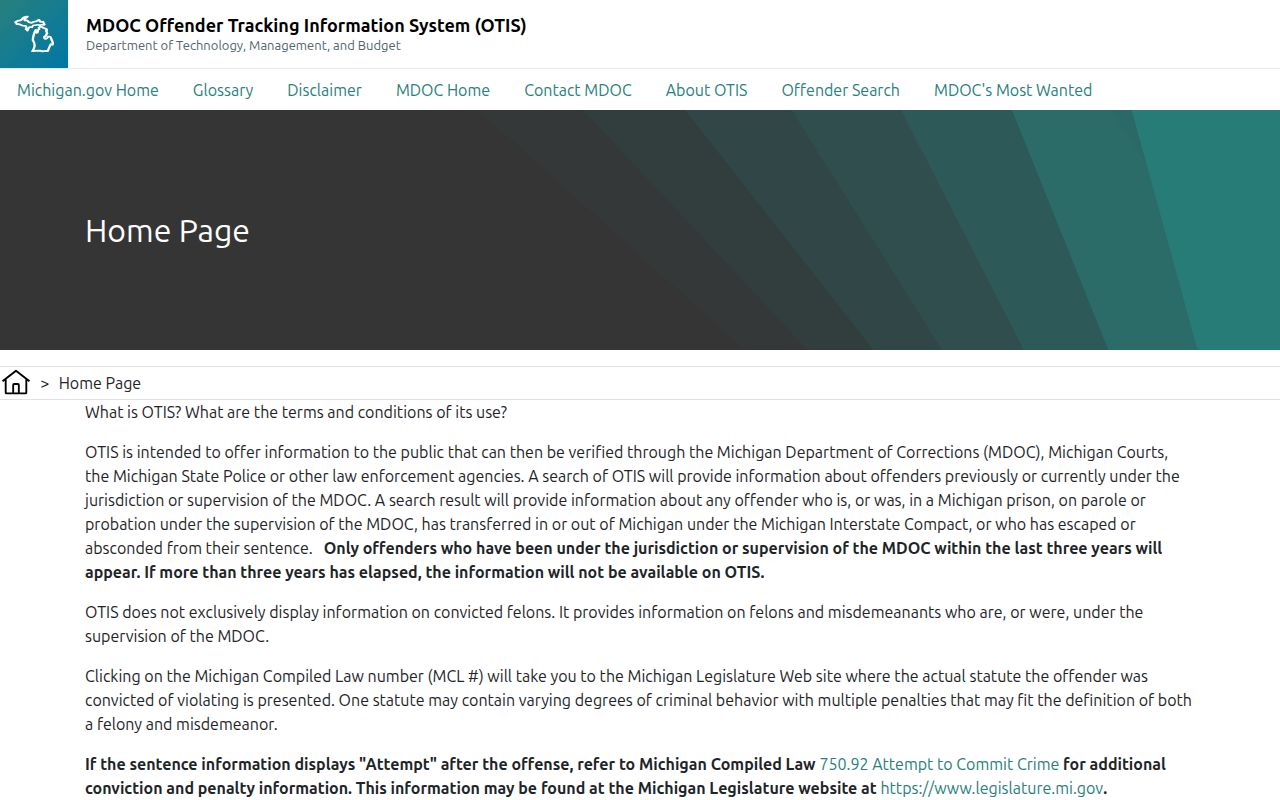
The Discharged, Parolee, Probationer, and absconder choices keep unlike supervision records from being read as the same status.
OTIS verifies MDOC status. It does not replace the Sheriff release record for a jail-only Presque Isle County case.
Note: OTIS generally displays discharged offenders for three years, so an older absence requires a records or court check.
Presque Isle County Supervision Office
Presque Isle County belongs to MDOC Region 3. The official Region 3 directory identifies the local parole and probation office in Rogers City. That office is the right place to ask about supervision facts that can lawfully be disclosed or to report a supervision-related OTIS error. It is not the keeper of a jail-only booking or release record.
MDOC Presque Isle County Parole/Probation
151 E. Huron Avenue
Rogers City, MI 49779
989-734-5260
Office hours were not verified in the cited directory. Call before visiting.
The street address is also used by county and court offices, which can cause confusion. The agencies are still separate. Name the office and use its direct phone number. The 89th District Court deals with misdemeanors, felony preliminary stages, arraignment, and bond. The 53rd Circuit Court handles felony proceedings and sentences. MDOC Field Operations handles state supervision.
When a record issue comes from a judgment, sentence, or court order, contact the clerk of the court of record. When the disputed item is a supervision location or absconder notation, start with the MDOC office. A request for the physical time someone left the county jail belongs with the Sheriff, even if probation began on the same case.
Presque Isle County Absconder Records
OTIS has distinct filters for Parole Absconders and Probation Absconders. An absconder entry means MDOC records the person as failing to remain available or report under supervision requirements. It is not a discharge. Michigan law, including MCL 791.238, keeps a parolee under legal custody and permits warrant action. An apparent release from one jail does not cancel that authority.
MDOC directs information about an absconder's whereabouts to local law enforcement and publishes an Absconder/Escapee Tip Line at 517-755-0855. Immediate safety issues belong with 911 or local law enforcement, not an informational office. A caller should not try to detain or confront anyone. The public status can lag an operational change, so the supervising office remains the correction channel for a stale or disputed entry.
VINELink serves a different role. It can send custody-change notices for a participating jail or MDOC record, but it is not a complete supervision ledger. A VINE release notice from one custodian can occur while a parole warrant, transfer, or another hold remains active. Read the reporting agency before drawing a conclusion.
Note: “Absconder” signals unresolved supervision, while “Discharged” signals that the listed MDOC term has ended.
Parole Board and Presque Isle Releases
The Michigan Parole Board is the sole paroling authority for felony offenders committed to MDOC. The Board gains jurisdiction under MCL 791.234 when sentence and eligibility rules are met. Eligibility does not equal release. The Board reviews the case, may grant or deny parole, and can suspend a grant if new misconduct or adverse information arises before the person leaves prison.
MDOC says parole consideration often begins about six months before eligibility or reconsideration. Even after a grant, the agency requires at least 28 days between the release decision and physical release. The Parole Release Unit then works on the date, term, special conditions, placement, and required notices. Those steps explain why a proposed date can change without a new county jail entry.
Routine parole interviews are not listed on a general public calendar. MDOC's public-hearing notices concern limited Lifer Law, commutation, and pardon matters, not ordinary parole consideration. For a named person, OTIS status and dates are the public starting point. The Board can answer public process questions, while protected case information remains limited.
Presque Isle Release Registry Limits
The Michigan Public Sex Offender Registry can corroborate community status only for people who are legally required to register. It offers name, registration or MDOC number, and geographic searches. Published statuses may include Active, Incarcerated, and Absconder. An Active status may support that a registrant lives in the community, but it supplies no universal jail release date.
This registry is not a general Presque Isle County parole or probation search. An absent result can have many lawful explanations, including that the offense is not registerable, a registration term ended, a court ordered removal, or the person is outside Michigan. The Track Offender email feature is separate from a VINELink custody alert. Neither replaces an OTIS record, court order, or Sheriff release record.
Use the registry only when SORA status is relevant to the record question. For ordinary parole and probation verification, the individual OTIS entry and MDOC office are more direct. This keeps each system within its actual scope and avoids turning a narrow registry into a broad release claim.
Presque Isle County Supervision Discharge
Supervision ends through a discharge or other lawful termination reflected by the responsible agency or court. For an MDOC case, a Discharged OTIS status supports that the listed sentence and supervision have ended. Michigan keeps many discharged entries online for three years. The public display period is not the same as the life of the underlying government record.
Older MDOC information may be available through the department's past-prisoner records contact for up to six years post-release or through a focused public-record request. A court docket can also show probation discharge or a later order, subject to participation, confidentiality, set-aside status, and online display limits. For the full custody and record sequence, the Presque Isle County released inmate search and release-record path separates Sheriff, court, and MDOC evidence.
A set-aside can change official public visibility. If a court-derived fact is wrong, the sentencing court is the proper correction source; MDOC updates its record from the controlling order or supervising agent. An old screenshot should not override a current official status. Final verification comes from the office that created or now maintains the record.
Note: A person may be off supervision while the underlying court or agency record remains subject to its own retention rules.